


Main Shutoff Mastery: Find It, Label It, Test It—Before You Need It
When a pipe bursts or a toilet supply line fails, the only thing that matters is how fast you can stop the water. That’s why every Boise/Meridian home needs a known, labeled, and tested main shutoff. This guide shows you exactly how to find yours (city vs. well), label it so anyone in the house can use it, and test it safely—today, not in the middle of a flood.
The 10-Minute Game Plan (overview)
- Locate the main shutoff (inside) and the meter box (outside).
- Identify what type of valve you have (ball vs. gate).
- Exercise the valve (close → open) and confirm it works.
- Label it with a big, unmistakable tag.
- Map & mark secondary shutoffs (water heater, irrigation, softener, unit shutoffs).
- Snapshot photos on your phone and share with the household.
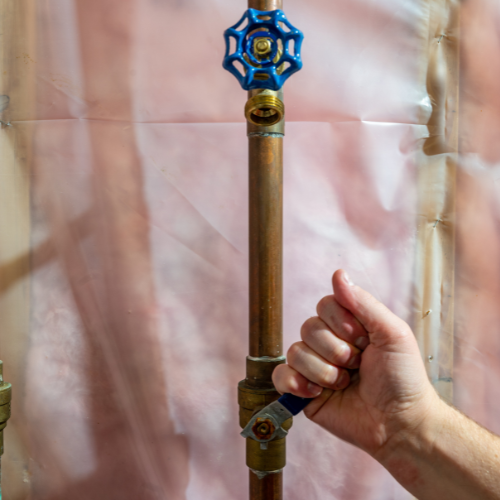
Step 1: Find your main shutoff (city water)
Start at the water meter—a rectangular lid near the curb. Draw an imaginary line from that box to your foundation; the main usually enters the house on that side.
Most common indoor locations:
- Garage wall near the water heater or softener
- Crawlspace just inside the foundation wall
- Utility/laundry room floor or wall entry
- Basement wall facing the street
Pro tip: Look for a copper or PEX line entering through the slab or wall with the first valve on it. That’s your main.
Step 1 (well systems): the well & pressure tank
If you’re on a well, the practical “main” is the shutoff at the pressure tank (usually in the garage, utility room, or pump house). You may also have:
- A separate yard line shutoff going to irrigation
- A pump breaker in the electrical panel (label it)
Close the pressure tank outlet to stop water to the house, then kill power to the pump if there’s a major break.
Step 2: Know your valve type (so you turn it right)
- Ball valve (best): Quarter-turn handle. In line = ON. Crosswise = OFF.
- Gate valve (older): Round wheel. Turn clockwise to close, counterclockwise to open. These can stick or fail to seal completely.
If you have a sticky gate valve, make a note to upgrade it. We swap them to quarter-turn ball valves during service via All Services.
Step 3: Test the shutoff (safe, simple, and quick)
- Tell everyone you’re testing—no water use for 5 minutes.
- Close the main valve.
- Open a cold tap inside; it should go to no flow within seconds.
- If water keeps dribbling:
- Check that the valve is fully closed.
- If you have a pressure tank, open a faucet to bleed remaining pressure.
- Re-open the main, then run a faucet for 30 seconds to clear air.
If the valve won’t turn or leaks at the stem: stop and book All Services. Forcing it can snap the stem.
Step 4: Label it so anyone can act
Print or handwrite a tag and zip-tie it to the valve. Put a second tag on the meter key (if you have one) or note where to find it.
Printable tag (copy/paste):
MAIN WATER SHUTOFF (WHOLE HOUSE)
TURN: 1/4 TURN HANDLE — PARALLEL = ON, PERPENDICULAR = OFF
IN AN EMERGENCY:
1) TURN THIS VALVE OFF
2) TURN OFF WATER HEATER (GAS OR ELECTRIC)
3) CALL A+ DRAIN CLEANING & PLUMBING
For gate valves, change the middle line to:
TURN: CLOCKWISE = OFF, COUNTERCLOCKWISE = ON
Tape the same instructions inside a nearby cabinet or on the wall.
Step 5: Mark the “Big Three” secondary shutoffs
- Water heater
- Cold inlet (top right on most tanks).
- Gas shutoff (quarter-turn lever at the flex line) or electric breaker.
- Irrigation/yard
- Backflow and zone valves—know how to close in winter.
- Water softener/conditioner
- Bypass lever (practice moving it).
Put small tags on each: “Heater Cold Inlet,” “Heater Gas,” “Softener Bypass,” “Irrigation Shutoff.”
City vs. well: quick reference
System | “Main” to Use | Also Do This |
City water | Inside main shutoff; outside curb stop (meter) as last resort | Keep a meter key handy; know which panel breaker feeds the electric heater |
Private well | Pressure tank outlet shutoff | Kill pump power at the breaker during big leaks |
What to keep next to the valve (mini kit)
- Meter key or curb-stop wrench (city water)
- Headlamp/flashlight
- Zip ties + extra tags
- Adjustable wrench & screwdriver
- Towel and small pan (for drips while you work)
If you’re already leaking—do this in order
- Kill the main (inside).
- Turn off the water heater fuel or breaker.
- Open a lower tub or laundry faucet to depressurize.
- Move electronics and rugs away from the leak path.
- Call Emergency Plumbing for stabilization and repairs.
Future-proofing (nice upgrades that pay off)
- Swap old gate valves for quarter-turn ball valves.
- Add a second main in the garage if the only shutoff is in the crawl.
- Install smart leak sensors near the heater, softener, and laundry.
- Label the breaker for the well pump or electric heater in plain English.
- Add an accessible cleanout near the front of the house to speed service.
For simple labeling, mapping, and a quick whole-home shutoff test, book a visit via All Services—we’ll leave you with tags and photos everyone in the house can follow.
FAQs
Is it okay to close the main for a few hours?
Yes. Shut off the water heater’s gas or power if it’ll be off long, then reopen the main slowly to avoid hammer.
The outside curb stop looks stuck. Should I force it?
No—those are city-owned. Use your inside main and contact us or the utility if the curb stop must be operated.
My valve weeps at the stem when I turn it.
That packing can often be snugged gently, but if it’s brittle, replacement is smarter. We can swap it without re-plumbing the whole entry.